ISO 10002:2018 Customer Satisfaction
 4.8
Our Rating for the course :
Stars Based on 35 users
4.8
Our Rating for the course :
Stars Based on 35 users
About ISO 10002:2018 Customer Satisfaction
🟢 ➤ ISO 10002:2018 is an international standard providing clear guidelines for handling customer complaints in a structured, transparent, and customer-focused way.
🔵 ➤ It helps organizations improve customer satisfaction by effectively addressing and resolving complaints while driving continual improvement.
🟠 ➤ Our service begins with a comprehensive gap analysis to assess your current complaint handling system against the standard’s requirements.
🟣 ➤ We then develop customized policies, procedures, and communication workflows tailored to your organization’s needs.
🔴 ➤ Staff training and internal audits are conducted to ensure everyone is aligned and your system is audit-ready.
🟡 ➤ We support the entire process including certification readiness, helping you achieve compliance smoothly and confidently.
🟢 ➤ With our expertise, your organization can enhance customer trust, elevate service quality, and align complaint management with international best practices.
Main Highlights
Customer-Focused Approach – Enhances customer satisfaction by prioritizing effective complaint resolution.
Structured Complaints Handling Process – Provides a systematic method for receiving, tracking, and resolving complaints.
Transparency and Accountability – Establishes clear roles, responsibilities, and procedures for complaint management.
Accessibility – Ensures the complaint process is easy to access and understand for all stakeholders.
Responsiveness – Emphasizes prompt acknowledgment and timely resolution of complaints.
Objectivity and Fairness – Promotes impartiality and consistency in evaluating and resolving issues.
Continual Improvement – Uses complaint data to drive improvements in products, services, and processes.
Integration with Management Systems – Can be aligned with ISO 9001 and other systems to support overall quality goals.
Communication – Encourages clear, consistent communication with complainants throughout the process.
Top Management Commitment – Requires leadership support and resources for effective implementation and continual review.
Brief about the ISO standard
→ISO 10002:2018 is an international standard that provides guidelines for handling customer complaints in a consistent, transparent, and customer-focused manner.
→It is designed to help organizations improve customer satisfaction by creating an effective complaints management system.
→The standard outlines best practices for receiving, managing, and resolving complaints, ensuring that customer feedback is handled efficiently and fairly.
→It emphasizes continual improvement, accountability, and responsiveness, helping businesses strengthen customer trust and loyalty.
→ISO 10002:2018 can be used by organizations of any size or industry and is often implemented alongside ISO 9001 (Quality Management Systems) to enhance overall quality and service.
-

Improves Customer Satisfaction Enhances trust and loyalty by resolving complaints effectively and fairly.
-

Structured Complaints Handling Provides a clear, consistent process for managing customer feedback.
-

Enhances Transparency and Accountability Defines roles and responsibilities, ensuring openness in complaint resolution.
-

Promotes Continual Improvement Uses complaint data to identify root causes and improve services and processes.
-

Supports Compliance and Certification Aligns with international standards, facilitating certification and regulatory adherence.
-

Boosts Organizational Reputation Demonstrates commitment to customer care and quality management.
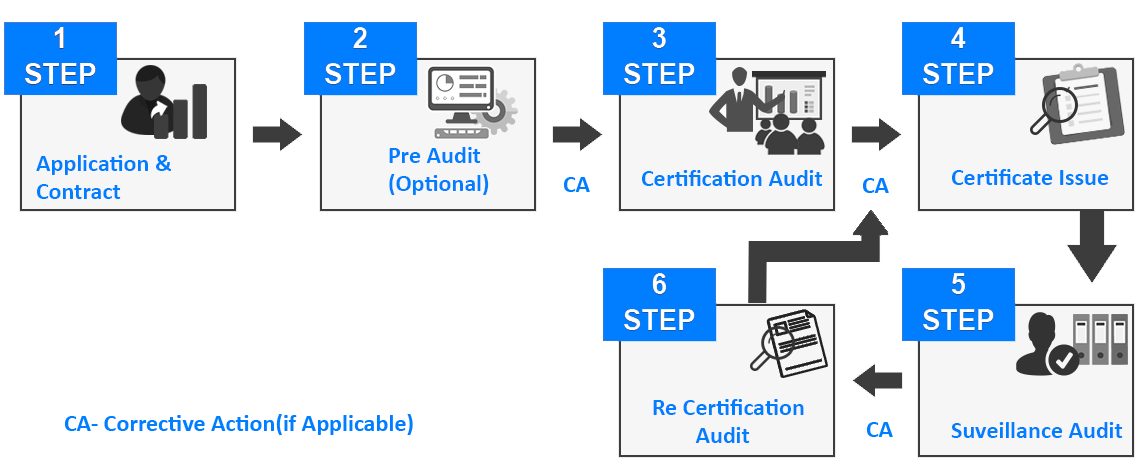
STEP 1: Application & Contract (Phase 1)
Purpose:
The organization formally begins the certification process by applying to a certification body (CB).
Activities:
- Submission of the application form with organization details.
- Discussion of the scope of certification (i.e., what part of the business or what standard is being applied for).
- Review of the organization's readiness.
- The certification body issues a quotation or proposal.
- Signing of a contract that outlines terms, conditions, audit plan, and costs.
Outcome:
- A legally binding agreement between the organization and certification body.
- Audit process planning starts.
STEP 2: Pre-Audit (Optional) (Phase 2)
Purpose:
To evaluate the organization’s current system and readiness before the formal certification audit.
Activities:
- A Pre Audit is performed to identify missing elements in the management system
- Evaluation of documentation, processes, and compliance with the chosen standard (e.g., ISO 9001).
- Feedback is provided but no certificate is issued at this stage.
Outcome:
- Organization receives a preliminary assessment report.
- Identifies areas for improvement before the actual certification audit.
- Optional, but recommended for first-time applicants.
STEP 3: Certification Audit (Phase 3)
Purpose:
To conduct a formal, in-depth audit to verify compliance with the applicable standard.
Activities:
- Conducted in two stages:
- Stage 1 Audit: Review of documentation, processes, and readiness.
- Stage 2 Audit: On-site audit of actual implementation.
- Auditors assess:
- Policy and objectives
- Risk assessments
- Employee competence
- Records and evidence of compliance
- If non-conformities are found, Corrective Actions (CA) must be taken.
Outcome:
- Audit report with findings.
- If all requirements are met (or after CAs are addressed), the process proceeds to certification.
STEP 4: Certificate Issue (Phase 4)
Purpose:
To grant official certification once the organization has passed the audit.
Activities:
- Review of audit report by the certification body.
- Verification of implemented corrective actions (if any).
- Issuance of the Certificate of Conformance, valid for typically 3 years.
Outcome:
- The organization becomes certified to the chosen standard.
- Public recognition, enhanced credibility, and business opportunities.
STEP 5: Surveillance Audit (Phase 5)
Purpose:
To ensure ongoing compliance with the standard during the certificate’s validity period.
Activities:
- Surveillance audits are conducted at least once a year.
- Partial audit of processes and systems.
- Review of continual improvement, internal audits, management reviews, and corrective actions.
Outcome:
- If compliant, the certificate remains valid.
- If issues are found, Corrective Actions (CA) must be taken.
STEP 6: Re-Certification Audit (Phase 6)
Purpose:
To renew the certification before its expiration (usually every 3 years).
Activities:
- A full system audit is performed, similar to the initial certification audit.
- Review of system performance over the previous cycle.
- Evaluation of effectiveness and continual improvement.
Outcome:
- A new certificate is issued for the next cycle if the audit is successful.
- If major non-conformities are found, certification may be suspended or withdrawn.
Corrective Action (CA) – Throughout the Process
- Applicable in Steps 3, 4, 5, and 6.
- If non-conformities are identified during any audit, the organization must:
- Investigate the root cause.
- Implement corrective actions.
- Provide evidence of resolution.
- Certification body verifies effectiveness of corrective actions before moving to the next step.
Certification Details

BAS is a versatile ISO certification body, with various industrial expertise and strong exposures in the field of Quality, Health, Safety and Environmental, Service Management and Information Security Management. We provide reliable services in the UK, Middle East, India and Other countries.
We at BAS with our veteran assessors provide you with certification which provides value for your management system. Many clients around the world have greatly benefited through our exemplary service.
The following are the steps in this phase we do as part of certification
Contract signature
BAS representative sends out an application which is a questionnaire to the organization which is the applicant for the Certification.
Once BAS receives the filled in application, the BAS representative sends an official quote to the applicant for approval.
Pre-audit (optional):
Gap analysis and diagnosis of your systems current position against requirements of the standard - A pre-certification audit is a high level evaluation indicating where your company currently stands in compliance with specific standards before the main certification audit.
Audit Stage 1- Initial Visit: to verify the establishment and implementation of the basic structure of your Management System
BAS will carry out a Document review Assessment of the client�s Management System according to the requirements of Standard in order to establish to what extent the System addresses the requirements of the standard and if a subsequent Initial Assessment for Accredited Certificate is likely to result in successful certification at an early stage, by which usually companies take the necessary corrective/preventive actions as appropriate and prior to the Initial Assessment. The Pre-audit should not be considered as a Consultancy Service
Audit Stage 2 - Certification audit (certificate issued after successful certification audit)
The principal purpose of the Initial Assessment is to audit the Company�s Management Systems for compliance with the the standard. Please note that Initial Assessment is the obligatory service. In this phase if there are any opportunities for improvements identified BAS auditors would report them in the interest of the organization.
Surveillance audits to follow the continual improvement
It is also an obligatory service; BAS will perform Surveillance Visit approximately after every year i.e. a total of 3 Surveillance Visits will be performed every year during the 3 years validation period of the Certificate. Such routine surveillance Visits are performed to ensure the continuous compliance of your Management System to the requirements of Standards.
Re-certification after 3 years through full audit or continual assessment.
What we do?
- BAS can assist your organization to acquire any relevant ISO certifications in UAE which is well-known internationally. It will generate additional business opportunities, exhibit the organizations compliance and commitment to the best-practices in any industries in order to be more competitive in today�s market.
- We at BAS with our veteran assessors provide you with certification which provides value for your management system. Many clients around the world have greatly benefited through our exemplary service.
- When you choose BAS as your certification partner you stand to gain monetarily in your business by our straight forward assessment. The overall aim of certification is to give confidence to all parties that a management system fulfills specified requirements. The value of certification is the degree of public confidence and trust that is established by an Impartial and competent assessment by a third party.
- With BAS, you will have the capability to deliver on the promises you make � this helps you to enhance your reputation, creates confidence in your capabilities, substantiates claims and differentiates your organization;
- With BAS, Obtains the full tangible benefits and value of your management systems � this helps you to link assessment system benefits to financial performance or improvements in effectiveness and efficiency that help drive your business forward in measurable and verifiable ways; and develops your capability to better manage a range of non-financial risks.
- As an integral part of this process, BAS will evaluate the relevance of the quality objectives against the analysis of stakeholder expectations and strategic goals of the company. We will assess the capability of the management system in controlling the defined processes. We will assess the effectiveness of the management decision making in respect to this data and, on the basis of this assessment, we will help senior management identify any changes required to support continual improvement.
- Providing more opportunities for improvements than just performing a compliance audit against the standards requirements.
- Understand the local culture and working patterns of the clients will facilitate better communication and understanding between BAS and the clients.
- BAS possesses resources who have the knowledge and skills of multiple standards such as ISO 20000, ISO 27001, SKEA for eg., in Abu Dhabi for Business Excellence programs etc.,. This greatly helps the clients to have better inputs as the standards can be applied in an integrated way and the auditors can provide a holistic feedback.
- BAS has offices around the world and the auditors have access to the knowledge from all around the global parts which will be helpful to the clients as they can have a better understanding and more practical suggestions from BAS auditors.
- BAS location advantage within the Emirates on the following: Abu Dhabi, Dubai, Al Ain, Sharja, Ajman, Ras Al Kaimah and Fujairah (We have successfully completed many and different projects locally and also internationally).
- BAS strongly promotes and implements the facilitations on the relevant Management System not only for the sake of certification but to really make a difference in the processes and procedures that will be implemented throughout any organization.
- BAS consist of some project members which are also EFQM International Assessors this can add value to the assignment as Abu Dhabi government is highly recommending Organizational Excellence program across Abu Dhabi Emirate (and UAE).